How to Optimize a Webflow Website for Answer Engine Optimization (AEO)
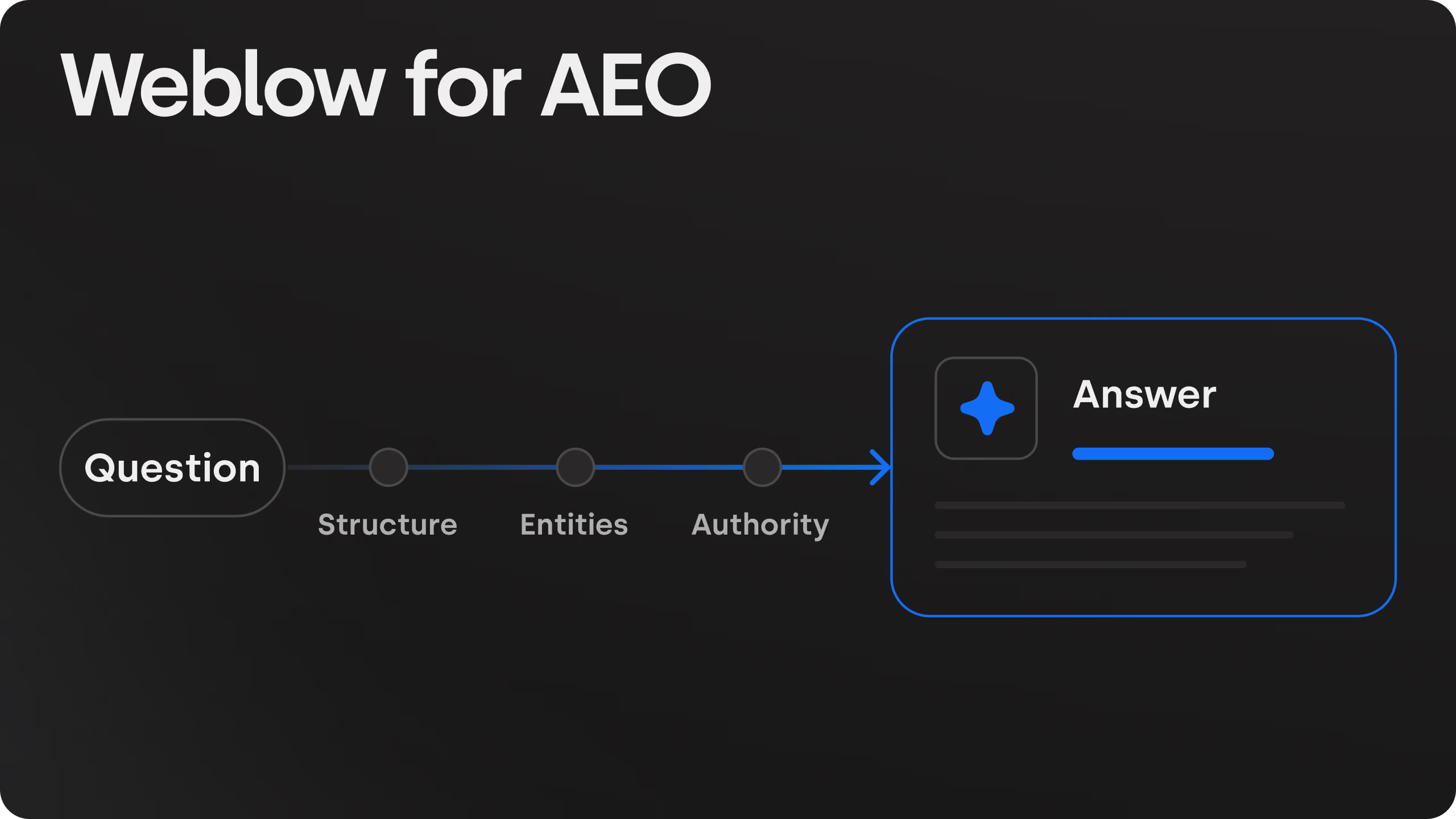
Optimizing a Webflow website for AEO means structuring your content so AI engines such as ChatGPT, Perplexity, Google AI Overviews, and Claude can understand, extract, and cite it when users ask relevant questions. It is not a single tactic or a standalone feature. Effective AEO spans nine implementation layers: semantic HTML, schema markup, FAQ architecture, metadata, llms.txt, topical authority, technical foundations, original data, and performance measurement.
The opportunity is already measurable. Webflow's SEO team reported that AI search grew from 2% to 8% of new signups in just eight months. Other research shows, users arriving from AI sources spend 28% longer on site than those coming from traditional Google search, while AEO-driven traffic can generate up to 40% higher conversion rates because visitors arrive pre-qualified, having already received a recommendation from a trusted answer engine.
This guide breaks down each of the nine layers and explains how they work together to improve citation across AI engines.
Along the way, you'll learn:
- how ChatGPT, Perplexity, Claude, and Google AI Overviews evaluate Webflow content
- which pages to prioritize first for AEO impact
- what technical elements increase citation potential
- why precise AI citation tracking is impossible
- which metrics matter instead, including why direct traffic is one of the strongest leading indicators of AEO success
Whether you're launching a new Webflow site or improving an existing one, this framework will help you build content that performs in both traditional search and AI-generated answers.
What Is AEO, and Why Does It Matter for Webflow Sites?
AEO (Answer Engine Optimization) is the practice of structuring your content so AI-powered answer engines surface, cite, and summarize it when users ask relevant questions. Traditional SEO focuses on ranking in search results pages. AEO shifts the focus to being the answer, having your content directly referenced by AI engines when they respond to user queries.
This distinction matters. Google AI Overviews are now appearing on the majority of informational queries. Traffic that does reach your site from AI search converts at significantly higher rates than traditional organic, because those visitors have already been informed, filtered, and pointed at you by an AI engine. Webflow's own SEO team reported that 8% of new signups came from AI search as of mid-2025, up from 2% eight months prior.
The engagement data confirms this. Users arriving from AI sources like ChatGPT and Perplexity average 10.4 minutes per session, 28% longer than the 8.1 minutes spent by users arriving from traditional Google search. They arrive pre-qualified with specific intent, which translates directly into lower bounce rates and higher conversion rates. Studies show AEO-driven traffic produces up to a 40% boost in conversions compared to traditional organic traffic.
The commercial opportunity behind this traffic is significant. The estimated financial impact of ChatGPT on commercial purchasing decisions across all industries exceeds $8.2 trillion:
- IT Services alone accounts for $936 billion;
- B2B SaaS sits at $229 billion;
- Fintech and Financial Services combined represent over $156 billion;
These are not impulse-purchase categories, they are high-consideration decisions where buyers are actively problem-solving. What most businesses miss is that commercial search represents only 5–6% of ChatGPT usage, but that is still 10x higher than transactional intent in traditional Google search.
<highlight>
The Behavioral Shift Behind AEO: Why does AI traffic convert so much better than organic?
Because AEO is not just a traffic channel, it is a trust channel. Research into AI consumer behavior identifies a structural shift at the core of this: for the first time, a single platform has absorbed the functions users previously distributed across multiple tools — factual lookup, opinion-seeking, peer advice, solution research — consolidating them into one trusted interaction environment. When an AI engine that a user consults daily recommends a brand, that recommendation does not register as advertising, it registers as trusted guidance.
That trust transfer is compounded by how AI answers are constructed. Unlike a Google result that appears identically to every searcher, an AI answer is filtered through the user's prior queries, chat history, and context, making the brand recommendation feel personally relevant rather than generically served. Visibility in an AI answer carries an implicit endorsement from a platform the user already relies on. That is why conversion rates from AI-referred traffic consistently outperform traditional organic.
(Source: AEO Deep Sh!ft Newsletter No. 1 & 2)
</highlight>
How to Optimize a Webflow Website for AEO: 9 Implementation Layers
Webflow gives you direct control over every signal AI engines rely on, semantic structure, schema markup, metadata, CMS architecture, without touching code for most of it. The platform does not reward you for that control automatically. What follows covers every implementation layer:
- content structure,
- schema markup,
- FAQ architecture,
- metadata,
- the llms.txt file,
- topical authority,
- technical foundations,
- original data,
- and measurement.
Some are one-time setup tasks. Others, content freshness, FAQ expansion, prompt testing, are ongoing.
1. Structure Content for Machine Readability
AI engines rely on clean, parseable code to understand what your content means, not just what it says. If your page structure is ambiguous, AI crawlers can't chunk it correctly, and that means they can't cite it accurately.
Use semantic HTML. Webflow's native elements — <main>, <nav>, <header>, <footer>, <section>, <article> — tell machines what each region of your page represents. Using generic <div> wrappers for everything eliminates that signal. In the Webflow Designer, choose the correct element type for every container.
Maintain a clear heading hierarchy. One H1 per page. Logical H2s for major sections. H3s for sub-points within those sections. AI engines chunk your content by heading level, if your heading structure is based on how text looks rather than what it means, the chunking algorithm splits ideas mid-concept and destroys meaning.
A heading like "Why This Matters" gives AI nothing; "Why Schema Markup Improves AEO for Webflow Sites" gives it everything.
Front-load answers. Put the most important answer in the first 100–200 words of each page or section. AI engines favor direct, early answers. They are not reading for suspense. If your core claim is buried in paragraph six, it will not be extracted.
Write extractable content. Short paragraphs. Plain language. One idea per section. Self-contained sentences that make sense without surrounding context. Test each key claim by reading it in isolation, if it doesn't stand alone, rewrite it.
<highlight>
AI Doesn't Choose Your Brand, it Predicts It: What This Means for Your Webflow Content
Research published in AEO identifies a mechanical reality that most AEO guides overlook: despite the conversational sophistication of modern AI interfaces, every major model — ChatGPT, Gemini, Perplexity — operates on the same underlying engine. Rather than reading and evaluating content the way a human researcher would, LLMs predict the statistically most probable next token in a sequence, based on patterns absorbed during training. The model is not judging quality, it is completing a probability calculation.
This has a direct consequence for how Webflow content should be structured. According to the same research, the content characteristics that increase citation probability are those that align with how token prediction works:
- unambiguous definitions that require no interpretive gap-filling;
- ideas that develop in a logical sequence so each sentence increases the probability of the next;
- consistent use of the same terminology throughout so the model builds reliable associations;
- hierarchical section structure that makes the content predictable to parse;
- and sufficient depth on each topic that the model's self-attention layers can build a stable contextual representation.
Practical test: running the same problem-resolution query simultaneously in ChatGPT incognito mode and Google will return substantially different results. The content that surfaces in ChatGPT is structurally different from the content that ranks in Google, a gap that widened considerably with the shift from GPT-3 to GPT-4 and has continued to grow. Content optimized for keyword density and backlink signals performs differently from content optimized for semantic predictability. For Webflow sites, this means structural decisions, heading hierarchy, paragraph length, terminology consistency, are mandatory.
(Source: AEO Deep Sh!ft Newsletter No. 7)
</highlight>
2. Implement Schema Markup (Structured Data)
Schema markup is how you tell AI engines exactly what your content represents. It is the highest-impact technical change most Webflow sites can make for AEO.
In Webflow, schema is added via Page Settings → Schema Markup (for AI-generated schema) or via the Custom Code → Before </body> tag field for manual JSON-LD. JSON-LD is the recommended format, it's easier to maintain, easier to validate, and what Google recommends.
<highlight>
Schema Won't Save You: What Actually Drives AI Citations on Your Webflow Site
Testing published in AEO challenges one of the most commonly repeated recommendations in AEO guides: that schema markup drives AI citation. After running controlled A/B tests across multiple client sites and conducting independent audits on others, the researchers found a consistent result, schema implementation produced no measurable improvement in LLM citation rates.
The explanation is mechanical rather than strategic. Schema markup is a signaling layer built for Google's crawlers, designed to produce rich results and featured snippets in traditional search. LLMs do not parse structured data markup when generating responses. They process the semantic content of the text itself, the meaning, structure, and relationships between ideas expressed in the actual copy. A FAQPage schema tag does not make a poorly written answer more likely to be cited. A well-structured, semantically clear answer in plain text outperforms a schema-tagged page with weak content every time.
Practical implication: schema is worth implementing correctly because it delivers real SEO value, improved rich results in Google Search, featured snippet eligibility, and structured entity signals. But treating it as the primary AEO lever misallocates effort. According to the same research, the factors that actually determine AI citation rates are content structure and semantic clarity: how clearly ideas are expressed, how logically they flow, and how specifically they address the user's problem.
(Source: AEO Deep Sh!ft Newsletter No. 8)
</highlight>
Schema types to implement by page:
@id referencing is the part most implementations skip. Individual schema blocks on each page are table stakes. Connecting them into a unified entity graph through @id references is what builds the machine-readable knowledge graph that AI engines trust. Your Organization entity should reference your Author entities. Your Article entities should reference your Organization. When these are linked, AI systems can verify your content comes from a real, consistent, trustworthy source.
Add FAQPage schema wherever you have Q&A content, not only on a dedicated FAQ page. Homepages, service pages, and case studies with question-format sections all qualify. This is one of the most reliable formats for earning AI citations, because answers become individually extractable.
Validate everything. Use Google's Rich Results Test or Schema.org's validator before publishing and run validation after any significant content update.
3. Add FAQ Sections to Every Important Page
FAQ sections are the most reliable content format for AI citations. When Perplexity, ChatGPT, or Google AI Overviews summarize a topic, they pull from pages with clear, self-contained question-and-answer pairs. These are the easiest content units for language models to extract and reuse.
Structure matters more than volume. Five well-written FAQ items outperform twenty vague ones.
Rules for AEO-effective FAQ content:
- Questions should mirror real search queries: not "What is SEO?" but "How do you optimize a Webflow site for AEO?"
- Answers should be 40–60 words: direct, the core response in the first sentence.
- Each answer must be self-contained: it must make sense without reading the question first.
- Write in a neutral voice: "Schema markup is..." not "We use schema markup to..."
- One idea per answer: no compound answers trying to cover multiple points.
<highlight>
FAQ Sections are a Tactic, Not a Strategy
Research published in AEO draws a clear distinction between FAQ sections as a tactic and FAQ sections as a complete strategy. The finding is that FAQ blocks are the most structurally convenient unit for AI extraction — short, self-contained, and easy to parse — but they are not what generates topical authority. What actually drives citation rates is the quality and depth of the content surrounding those FAQ blocks: whether the main body of the page addresses the underlying problem comprehensively, whether each section provides a genuine problem-resolution framework, and whether the technical depth is sufficient for the model to treat the source as authoritative.
The same research highlights how query intent determines which content gets cited versus which gets ignored. The distinction is not about topic, it is about the specificity and constraint-level of the question being asked. A query like "What is payment orchestration?" signals a user at the beginning of a research journey. A query like "How do I implement payment orchestration for recurring billing without disrupting an existing checkout flow?" signals a user with a live problem, specific constraints, and immediate decision-making intent. According to AEO Deep Sh!ft No. 8, these two queries require entirely different content strategies and it is the second type, specific, constraint-heavy, and problem-resolution in framing, that produces qualified traffic rather than impressions alone.
(Source: AEO Deep Sh!ft Newsletter No. 8)
</highlight>
Here is the strategic reason to go deep on FAQ content: the internet lacks it. Despite 90% of all internet data being created in the last two years and 402.74 million terabytes of new data being generated daily, there is a severe shortage of deep, specific problem-resolution content on most professional topics. Ask ChatGPT a surface-level question and you get a polished answer. Push three or four layers deeper into a niche problem and the quality deteriorates fast, because the content simply does not exist.
Only 0.69% of Google searches are transactional, where users are ready to make a purchase. Traditional SEO conditioned marketers to ignore those queries and chase high-volume informational content instead. That left a massive gap in the deep, specific, problem-resolution content that both converts and gets cited in AI answers. For every FAQ page you build around specific, intent-driven queries your competitors have not touched, you are filling a vacuum rather than fighting for position.
In Webflow:
- add FAQ fields to your CMS collection (Plain Text fields, not Rich Text, cleaner for schema injection);
- build a reusable FAQ component in the Designer. Make sure the full answer text is in the DOM, not hidden via CSS, so AI crawlers can read it;
- add FAQPage JSON-LD schema to every page where FAQ content appears.
Pull your FAQ questions from Google Search Console's Queries report. Filter for question-format queries (who, what, how, why, when) sorted by impressions. These are the exact questions your audience is already asking. Answer the top 5–10 per relevant page, rather than creating one catch-all FAQ hub, topically relevant FAQs on each page perform better than a generic FAQ page.
4. Build AI-Friendly Metadata
AI crawlers also read your metadata to get a fast summary of each page before committing to a full crawl.
Title tags should be under 55 characters. They should be specific: "How to Optimize a Webflow Website for AEO" outperforms "AI Search Optimization Tips for Modern Websites."
Meta descriptions should run 100–105 characters. Lead with the most important claim. They should read as a direct answer to the implied question behind the keyword.
Image alt text must be descriptive and meaningful on every image. AI systems use alt text to interpret visual assets. Leaving it blank is a lost citation opportunity. "Webflow Page Settings showing the Schema Markup field" is useful, "Image 1" is not.
Open Graph tags matter for brand consistency across AI summary panels that pull from social metadata. Keep OG titles and descriptions aligned with on-page content.
5. Add an llms.txt File
An emerging best practice for Webflow AEO is placing a plain text file at the root of your site, yourdomain.com/llms.txt, that gives LLMs a summary of your site's structure, key pages, and brand positioning. This file works like a machine-readable About page for AI engines.
Include:
- company name,
- what you do,
- who you serve,
- your core services,
- key pages with descriptions,
- and any fact you want AI systems to treat as canonical about your brand.
Webflow now includes documentation on how to upload this file through hosting settings. It takes under an hour to set up and is one of the lowest-effort, highest-signal additions you can make.
<highlight>
AI Doesn't Read Your Website, it Reads Your Entire Digital Footprint
According to research documented in AEO, AI answer engines do not limit their brand assessment to a single source. They draw on a wider information landscape, your primary website, directory profiles, review platforms like Clutch, media coverage, and third-party listings and compare signals across all of them. Where those signals contradict each other, the model's confidence in the entity weakens. Consistency between what your llms.txt file declares and what every other indexed source confirms is what produces a strong, citable entity signal.
The same research maps AEO against every existing marketing channel and finds none of them accommodate what AI answer engines actually do. Organic search is a static exchange constrained by the search bar. Social reach is bounded by algorithms. Referral traffic places brands inside paid listings with no room for dialogue. AI conversations are adaptive, shaped by the user's history, prior queries, and context, and trust is conveyed through relevance rather than repeated exposure. A brand appearing in an AI answer is not merely displayed. It is positioned as the contextually appropriate response within that user's specific decision-making environment. For that positioning to hold across queries, entity signals need to be consistent across every surface the model can read.
(Source: AEO Deep Sh!ft Newsletter No. 3)
</highlight>
6. Build Topic Clusters and Topical Authority
AI engines cite sources they consider authoritative on a topic. Isolated articles don't build that, but structured content clusters do.
For each core topic, create:
- A pillar page that covers the full topic (e.g., "Complete Guide to Webflow SEO")
- Supporting articles that go deep on each subtopic (e.g., "Webflow Schema Markup," "Webflow Core Web Vitals," "Webflow CMS SEO")
- Internal links between all of them, using descriptive anchor text, not "click here," but "how to implement FAQPage schema in Webflow"
Maintain consistency. Your brand, service definitions, and core claims should appear identically across your Webflow site, your social profiles, and any third-party directories. Discrepancies between what your site says and what your Clutch or LinkedIn profile says weaken your entity signal.
<highlight>
The Two Factors That Predict AEO Success
The Enaks Master Report (2025) validated a predictive ranking formula across five controlled content experiments in the payment security space. Two factors accounted for 65% of total ranking power: Scope Alignment (35%) and Content Gap (30%).
Across all five cases, these variables determined outcomes before any other factor was considered. Content with strong scores in both areas consistently achieved first- or second-position rankings. When scope misalignment occurred, a 20–25 point penalty was applied that technical depth, data quality, and structural clarity could not offset.
The conclusion was clear: identifying the right topic and filling an unanswered gap is not one part of a content strategy, it is the foundation of ranking success.
Research published in AEO explains why these gaps exist. Years of SEO optimization have pushed content teams toward high-volume informational keywords that generate traffic but rarely convert. As a result, broad topics are oversaturated, while specific, problem-solving queries with strong buying intent remain underserved.
The brands that win in answer engines are not those with the largest content libraries, but those that answer questions nobody else has addressed. For Webflow agencies, a query such as "How do I migrate a WordPress site to Webflow without losing organic rankings during a rebrand?" represents exactly that type of opportunity.
(Source: AEO Deep Sh!ft Newsletter No. 5)
</highlight>
7. Webflow-Specific Technical Requirements
AEO builds on top of SEO. If your technical foundation is broken, AI engines deprioritize you the same way Google does.
Crawlability. Confirm your robots.txt isn't blocking important pages. Submit and validate your XML sitemap in Google Search Console. Make sure all primary pages are indexed.
Core Web Vitals. Page speed and performance directly affect how AI systems rank content quality. Webflow's managed hosting handles most of this, but heavy third-party scripts, unoptimized images, and interaction-heavy pages can still drag scores down. Run regular audits.
CMS architecture. Separate extractable data from body rich text. Create discrete CMS fields for: author, publish date, FAQ questions, FAQ answers, key statistics, and category. This makes it possible to generate dynamic schema across all CMS pages without manual JSON-LD per page and keeps your structured data in sync with your content automatically.
Canonical tags. Webflow sets canonical tags automatically, but review them for any pages where duplicate content could exist (e.g., filtered collection views, localized pages). Duplicate intent overlap dilutes your signal.
8. Publish Original Data and Expertise
AI engines increasingly favor content with unique information, data they can't get from aggregating five other sources.
Instead of "Webflow improves SEO," publish: "After migrating X clients from WordPress to Webflow, average page load times dropped by Y%." Case studies, client-specific outcomes, and original frameworks are far more likely to be cited than generic summaries of publicly available information.
This is where Webflow agencies have a structural advantage. If you've worked on 100+ projects, you have client data that no one else has. Use it, even anonymized, aggregated findings from your own work carry more authority signal than restated industry statistics.
Author attribution matters too. Add visible bylines, author bios with credentials, and clear "last updated" timestamps to every article. AI engines use these signals to assess credibility.
<highlight>
How AI Engines Evaluate Authority Differently
AEO Deep Sh!ft Newsletter documents a finance client that achieved first-page rankings in both Google Search and AI-generated answers within months, outperforming established competitors, including Visa and Mastercard, without acquiring a single backlink.
The differentiator was content specificity. Articles focused on highly targeted problems and provided enough technical depth to demonstrate direct experience rather than summarizing publicly available information. The finding challenges a common SEO assumption: backlinks can amplify authority, but they cannot create it.
The research also highlights a key difference in how E-E-A-T functions in SEO versus AEO. Traditional SEO relies heavily on external signals such as author credentials, bylines, and link profiles. AI systems place greater weight on the content itself: the quality of sources, evidence of hands-on expertise, originality of insights, and consistency across a body of work. For AEO, credibility is established within the content, not through the metadata surrounding it.
(Source: AEO Deep Sh!ft Newsletter No. 8)
</highlight>
9. Measure AEO Performance
AEO is harder to measure than traditional SEO, but not impossible.
For search-based AI visibility:
- Track impressions and clicks for question-format queries in Google Search Console
- Monitor featured snippet and rich result appearances for FAQ-schema pages
- Watch for "AI Overview" appearances in Google for your target queries
For LLM-based visibility:
- Test prompts directly in ChatGPT, Perplexity, and Claude. Ask the questions your clients ask. Check whether your brand is mentioned, whether your phrasing appears, whether your framework is echoed back.
- Track referral traffic from AI sources in GA4. Set up source/medium filters for ChatGPT, Claude, Perplexity, and other AI referrers.
- Ask every new inquiry: "How did you find us?" When the answer shifts from Google to an AI tool, that's a direct signal your content is being cited.
<highlight>
Why Accurate AEO Citation Tracking Is Impossible?
AEO Deep Sh!ft challenges a growing category of AEO tools by arguing that precise AI citation tracking is structurally impossible. LLM responses vary based on factors such as query phrasing, conversation history, model version, location, and timing, meaning two users asking the same question may receive different answers. Because these variables continuously change, no tool can reliably aggregate citation frequency across users and contexts.
Instead of pursuing precision, the research recommends a directional approach. Combine Google Search Console impression data for question-based queries with ICP insights, including job roles, intent stages, and audience pain points, to estimate where citation opportunities are most relevant.
Monthly prompt testing across ChatGPT, Perplexity, and Claude can then validate whether your brand, frameworks, or content are appearing in target responses. According to the research, directional insights tied to real audience intent are more valuable than dashboards claiming to track the untrackable.
(Source: AEO Deep Sh!ft Newsletter No. 10)
</highlight>
Indirect signals to monitor:
- Increase in branded search volume
- Increase in direct traffic
- More prospects using your terminology on calls
- More "I found you through AI" conversations
<highlight>
Why Direct Traffic Is the Leading Indicator of AEO Success
One of the biggest challenges in AEO is measurement. Unlike traditional search, AI platforms offer limited attribution, and emerging advertising models provide little additional clarity. AEO Deep Sh!ft No. 10 highlights this issue through ChatGPT's advertising launch, which introduced a reported $200,000 minimum spend and a $60 CPM without attribution infrastructure or performance dashboards. Across performance marketing communities, measurement failure emerged as the most frequently cited concern.
AEO Deep Sh!ft suggests a more practical approach: focus on the signals AI influence creates rather than trying to measure every citation directly.
Across client implementations where content was mapped to problem-resolution intent, structured for AI extraction, and organized around topical authority, the results included 159% organic growth, a 1,168% increase in direct traffic, 15% of total traffic originating from AI answers, and an average three-minute increase in time on page.
The most significant metric was direct traffic. As AI citations build topical authority, users who first discover a brand through AI-generated answers often return later through branded searches or direct visits. This sequence — AI citation, brand recognition, direct traffic — frequently occurs before attribution systems can capture AI influence reliably.
For that reason, direct traffic growth is one of the strongest leading indicators that an AEO strategy is working. The strategic objective is not to maximize citations for their own sake, but to build enough authority that users seek out your brand directly.
(Source: AEO Deep Sh!ft Newsletter No. 10)
</highlight>
Webflow AEO Checklist
Conclusion
AEO is not a replacement for SEO, it is the next layer of search visibility. The websites most likely to succeed in answer engines are not necessarily those with the strongest backlink profiles or the largest content libraries. They are the ones that answer specific questions clearly, demonstrate genuine expertise, and make their content easy for AI engines to understand and reference.
For Webflow teams, the opportunity is significant. The platform already provides many of the technical advantages that answer engines value: clean code, strong performance, flexible CMS structures, and granular control over content presentation. The differentiator is how those capabilities are implemented.
The framework outlined in this guide — from semantic structure and schema markup to topical authority and measurement — is designed to help you build visibility where search is heading, not where it has been.
If you're already using Webflow and want to strengthen your visibility across ChatGPT, Perplexity, Claude, Google AI Overviews, and other answer engines, Skywwward can help. We design and build Webflow experiences with both search and AI discoverability in mind, combining technical SEO, AEO implementation, content structure, and performance optimization into a single, scalable foundation. Explore our AEO services or discuss your project with our team.
.avif)
Frequently asked questions
What is AEO for Webflow?
AEO (Answer Engine Optimization) for Webflow is the process of structuring your Webflow site so AI engines, including ChatGPT, Perplexity, Claude, and Google AI Overviews can read, extract, and cite your content when users ask relevant questions. It combines semantic HTML, JSON-LD schema markup, question-based content, and topical authority signals.
Does Webflow support schema markup for AEO?
Yes. Webflow has a built-in Schema Markup field in Page Settings that lets you add or AI-generate JSON-LD structured data. You can also add schema manually via the custom code fields. For CMS-driven sites, schema can be bound to dynamic collection fields so each page gets unique, accurate structured data automatically.
Which Webflow pages should be optimized for AEO first?
Start with the pages that already rank in positions 4–15 for question-format queries in Google Search Console, these have existing authority and the highest probability of earning a featured snippet or AI citation with structural improvements. After those: homepage, primary service pages, and any page that directly answers a question your ICP is actively searching.
How is AEO different from SEO for Webflow?
Traditional SEO targets ranking positions in search result pages. AEO targets being cited as the direct answer in AI-generated responses. The technical foundations overlap significantly, clean HTML, fast pages, strong metadata, structured data, but AEO adds specific requirements: question-format content, self-contained extractable answers, FAQPage schema, and entity graph architecture. Good SEO is a prerequisite for AEO, not a substitute.
How long does it take to see AEO results on a Webflow site?
Schema markup changes can appear in Google Search Console within days of publishing. AI citation results (ChatGPT, Perplexity) are less predictable and depend heavily on topical authority, how much relevant content exists across your site, how recently it was updated, and whether your brand appears in the sources AI systems train on. Most sites see measurable signals within 60–90 days of systematic AEO implementation.
Can Skywwward implement AEO on our Webflow site?
Yes. Skywwward builds and optimizes Webflow sites for both traditional SEO and AEO, including schema architecture, CMS restructuring, FAQ content systems, and performance optimization. If your current Webflow site isn't structured for AI search, we can audit it and build the technical foundation from the ground up.